
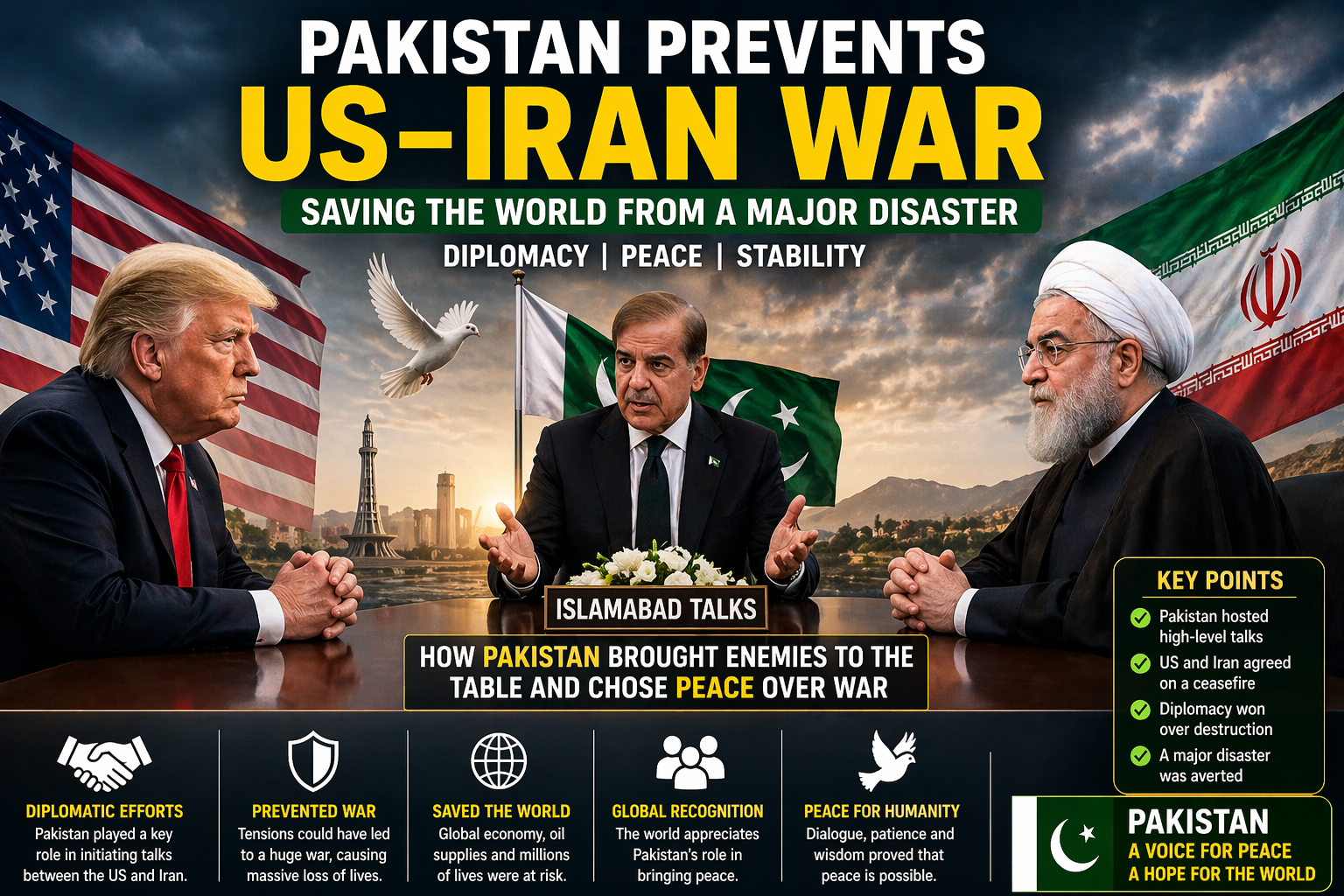
In a time when the world stood on the edge of a major conflict, Pakistan emerged as an unexpected but powerful force for peace. The rising tensions between the United States and Iran in 2026 had created fears of a full-scale war—one that could have devastated the Middle East and shaken the global economy.
But at the center of this crisis, Pakistan stepped forward—not as a participant in war, but as a bridge for peace.
A World on the Brink
The conflict between the United States and Iran had already caused significant destruction, with thousands of lives lost and global oil markets destabilized. A fragile ceasefire was in place, but it was close to collapse. The situation was so tense that even a small mistake could have triggered a wider war affecting multiple countries.
Global powers were concerned. Energy routes like the Strait of Hormuz were under threat, and the world economy was at risk.
Pakistan Steps In
Amid this uncertainty, Pakistan took a bold diplomatic initiative. Islamabad became the center of high-level peace talks between the US and Iran—an event now widely known as the “Islamabad Talks.”
Pakistan’s leadership, including Prime Minister Shehbaz Sharif and military officials, actively engaged with both sides. They coordinated with regional powers like Saudi Arabia, Turkey, and Qatar to build support for peace efforts.
The goal was clear:
Prevent war
Extend the ceasefire
Bring both sides to the negotiating table
The Role of Mediation
Pakistan maintained communication with both Washington and Tehran, even when trust between the two was extremely low. Diplomatic channels remained open, and Pakistan worked tirelessly to keep dialogue alive.
Islamabad was placed on high alert as it hosted these sensitive negotiations, showing how critical its role had become in global peace efforts.
Despite challenges, Pakistan succeeded in:
- Bringing both sides into talks
- Preventing immediate escalation
- Keeping the ceasefire from collapsing completely
Challenges and Tensions
The path to peace was not easy. Military actions, including naval blockades and ship seizures, threatened to derail the talks.
There were moments when negotiations almost failed, and both sides accused each other of violations. Yet, Pakistan continued its efforts without backing down.
A Major Global Impact
Even though a final agreement has not yet been fully reached, Pakistan’s mediation has already made a huge difference.
It prevented an immediate large-scale war
It gave diplomacy a chance over destruction
It reduced global panic and economic instability
Experts agree that without these efforts, the conflict could have escalated into a much larger and more devastating war.
Conclusion
Pakistan’s role in the US–Iran conflict of 2026 highlights the power of diplomacy in a divided world. At a time when war seemed inevitable, Pakistan chose dialogue—and in doing so, helped protect millions of lives and the global economy.
In simple words:
Pakistan didn’t just host talks—it helped save the world from a possible disaster.