
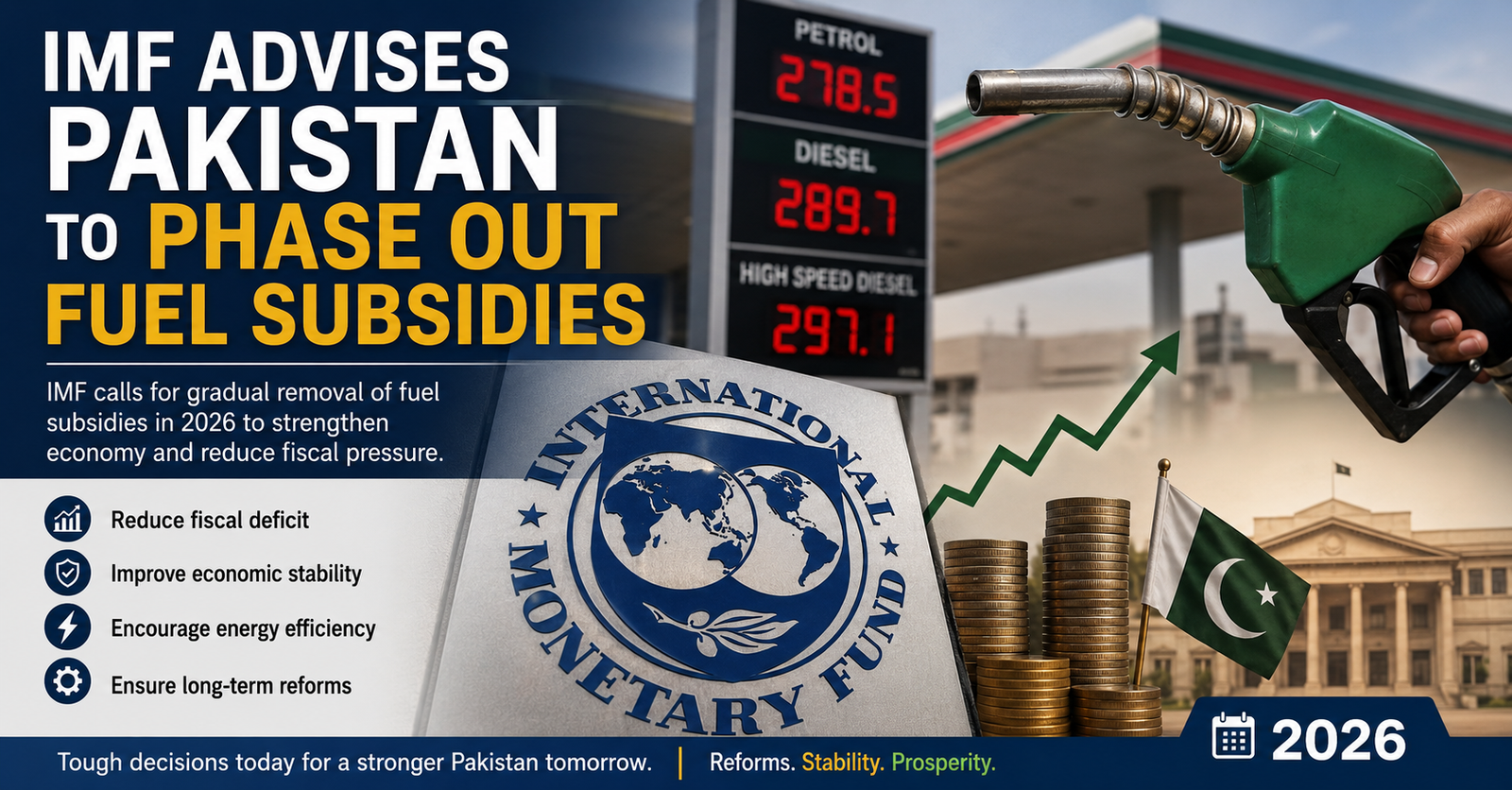
Pakistan is once again facing tough economic decisions as the International Monetary Fund (IMF) has advised the government to gradually phase out fuel subsidies in 2026. The recommendation comes as the country continues efforts to stabilize its economy, reduce fiscal pressure, and secure international financial support.
Fuel subsidies have long been used in Pakistan to provide relief to the public by keeping petrol and diesel prices lower. However, economists argue that these subsidies place a heavy burden on the national budget and increase financial instability during periods of rising global oil prices. The impact of increse the prices will specilly effect the peoples of Pakistan and lower middle class public who difficultly mange the expenses of home, electercity bill, gas bills and food product which is they daily use .
Why the IMF Wants Fuel Subsidies Removed
The IMF believes that fuel subsidies mainly benefit higher-income groups who consume more fuel, while adding billions of rupees to government expenses. According to economic experts, reducing subsidies can help Pakistan:
Lower its fiscal deficit
Improve foreign exchange reserves
Reduce unnecessary government spending
Meet conditions linked to IMF financial programs
Encourage energy conservation
The IMF has repeatedly stressed that Pakistan needs long-term structural reforms instead of short-term relief measures that increase debt pressure.
When the IMF demands from Pakistan the government of Pakistan does not implement the instructions of IMF.
Some time IMF instructions are friendly for Lower middle class public but government look own interests and not thought gor the public , sometime IMF give instructions to government that releif the lower middle class peoples and increase taxes on the rich peoples who do business, buy and sell and keep a large amount of wealth, but in the result if we analyze that the government give releif to wealthy peoples and creat difficulties for the lower middle class and increase the prices of daily uses product which are use the lower middle class peoples.
Impact on Petrol and Diesel Prices
If fuel subsidies are reduced or completely removed, petrol and diesel prices in Pakistan could rise further in 2026. This may directly affect:
Transportation costs
The transport prices will increse and will creat difficulties for the lower public of Pakistan.
Food prices
Usually its a fact that when increse the fuel prices the all the daily use food product prices are increase.
Industrial production expenses
In the result may be possible that the industrial products prices could expensive or Can Totaly close the industries and factories because of fuel prices.
Electricity generation costs
Electercity prices can increase due to the high fuel price because Pakistan use the fuel to produce the lot amount of electricity.
Daily household budgets
High fuel price can effect the daily household budgets because the all expenses will incresed.
Citizens are already dealing with inflation, and higher fuel prices may create additional pressure on middle and low-income families.In the Country the 80% peoples life will be tough due to all high expenses because the monthy income of peoples in Pakistan is very low.
So mange in this situation is very difficult.
Government’s Possible Strategy
Reports suggest that the Pakistani government may adopt a gradual approach instead of removing subsidies all at once. Officials are considering targeted relief programs for vulnerable groups while allowing market-based fuel pricing to continue.
The government may also focus on:
Expanding public transport systems
This system may be helpful for the mange the this situation
Promoting electric vehicles
Electric vehicles are best instead of fuel vehicles
Increasing renewable energy investments
It will be helpful for economy
Improving tax collection
If government collect the taxex from rich peoples its may possible that its will decrice the difficulties of lower middle class peoples problem.
Reducing circular debt in the energy sector
Its will best for energy secter and may be the electercity cost will reduce
These measures are aimed at reducing dependence on imported fuel and building a more sustainable economy.
Public Reaction in Pakistan
The possibility of rising fuel prices has sparked concern among citizens and businesses. Transporters, small business owners, and salaried workers fear that another increase in petrol prices could worsen inflation.
Many people believe the government should first control unnecessary expenditures and improve governance before placing additional burdens on the public. Others argue that economic reforms are necessary if Pakistan wants long-term financial stability and continued international support.
Pakistan’s Economic Challenges in 2026
Pakistan’s economy in 2026 continues to face several major challenges, including:
High inflation
Currency depreciation
Increasing debt repayments
Rising import costs
Energy shortages
Slow industrial growth
The IMF’s recommendations are part of broader economic reforms intended to stabilize the country and restore investor confidence.
Final Thoughts
The IMF’s advice to phase out fuel subsidies in Pakistan during 2026 represents a difficult but important economic decision. While removing subsidies could help strengthen Pakistan’s financial position and reduce budget pressure, it may also increase hardships for ordinary citizens already struggling with inflation.
The success of these reforms will depend on how effectively the government balances economic stability with public relief. Transparent policies, targeted support for low-income families, and long-term energy reforms will be crucial in helping Pakistan navigate this challenging period while protecting the welfare of its people.