
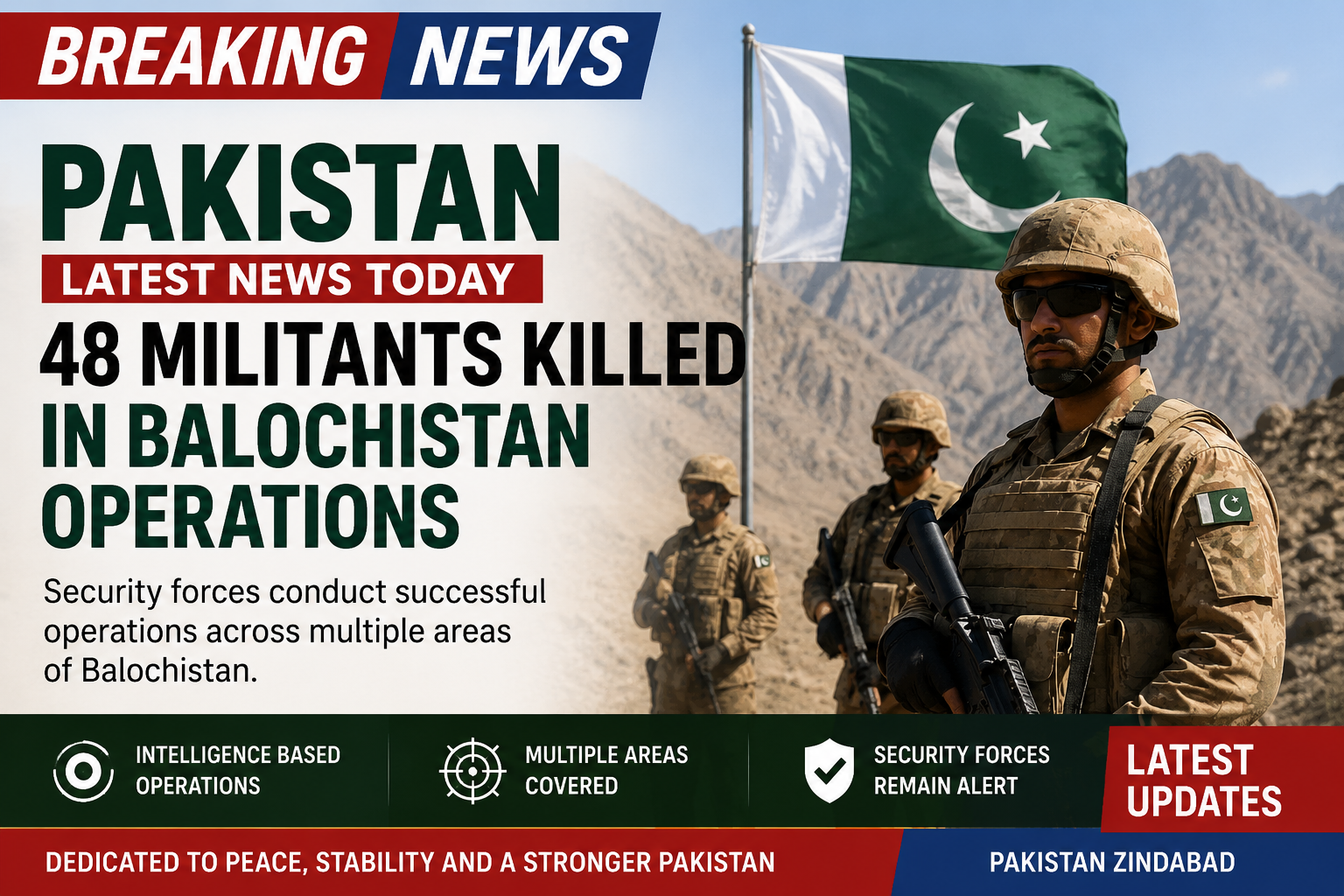
Pakistan Latest News Today: 48 Militants Killed in Balochistan Operations
Here’s what’s making headlines in Pakistan today, September 4, 2026: security forces have carried out a wave of intelligence-based operations across Balochistan, and the military says the toll stands at 48 militants killed over the last 72 hours.
The Inter-Services Public Relations (ISPR) put out a statement saying the operations played out across several districts — Mastung, Sibi, Quetta, and Kalat all saw action. Officials also said weapons and other military equipment were pulled out of the raids.
So what actually happened in Balochistan?
This isn’t a new story for Pakistan, unfortunately. Parts of Balochistan have been dealing with militant violence and separatist activity for a long time now, and it’s remained one of the country’s most serious security concerns.
These latest operations didn’t come out of nowhere — they followed a stretch of heightened security activity in the province. According to the military, forces moved on militant hideouts once intelligence confirmed where they were.
And the timing is notable: this comes just a day after Pakistan’s military said it had killed 15 militants who were trying to cross into North Waziristan from Afghanistan, in an engagement that reportedly dragged on for around 36 hours.
Why should anyone outside Balochistan care?
Balochistan is Pakistan’s largest province by area, and it matters strategically for a few big reasons — its borders, its mineral wealth, and the major infrastructure projects that run through it.
But zoom in past the strategic angle, and for the people who actually live there, this is about something much more immediate. Ongoing violence doesn’t stay contained to headlines — it bleeds into travel, into business, into schools, into just getting through an ordinary day.
That’s really the point here: these operations aren’t just another security bulletin to skim past. They’re part of a much longer, harder push by Pakistani authorities to get a handle on militant activity and bring some semblance of stability back to places that have gone without it for years.
The bigger security picture
There’s a wider thread running through all of this too — tension along Pakistan’s western border that hasn’t really let up.
Pakistan has, time and again, raised the alarm about militant groups operating out of, or slipping in through, Afghanistan. Afghan authorities have consistently pushed back on that, denying they’re backing any attacks against Pakistan.
The result is that border security and counterterrorism have become two of the defining challenges for Pakistan’s government and its security institutions — not a passing concern, but something they’re grappling with continuously.
What comes next?
Right now, the immediate question is whether security forces can hold the line — prevent further attacks and keep whatever stability’s been won in these areas from slipping away again.
But analysts and policymakers keep circling back to the same warning: military operations alone won’t get Pakistan to lasting stability. Economic development, real governance, tighter border management, and actual opportunities for the people living in these communities — all of that has to be part of the equation too, not just an afterthought.
For now, though, today’s announcement is one more reminder of just how much security still shapes daily life in Pakistan, especially in Balochistan and along that western frontier.
Pakistan Latest News
- 48 militants were reported killed in Balochistan operations over 72 hours.
- Operations were reported in Mastung, Sibi, Quetta and Kalat.
- Weapons were reportedly recovered during the operations.
- This follows the reported killing of 15 militants attempting to cross into North Waziristan.
- Security along Pakistan’s western border remains a major national concern.
Final thoughts
At the end of the day, today’s news out of Pakistan is a snapshot of just how tough the security landscape there continues to be. Authorities are framing these operations as a major counterterrorism win — and maybe they are. But real, lasting peace is never going to come from military action alone. It’s going to take that alongside political stability, economic opportunity, and governance that actually delivers for people on the ground.