
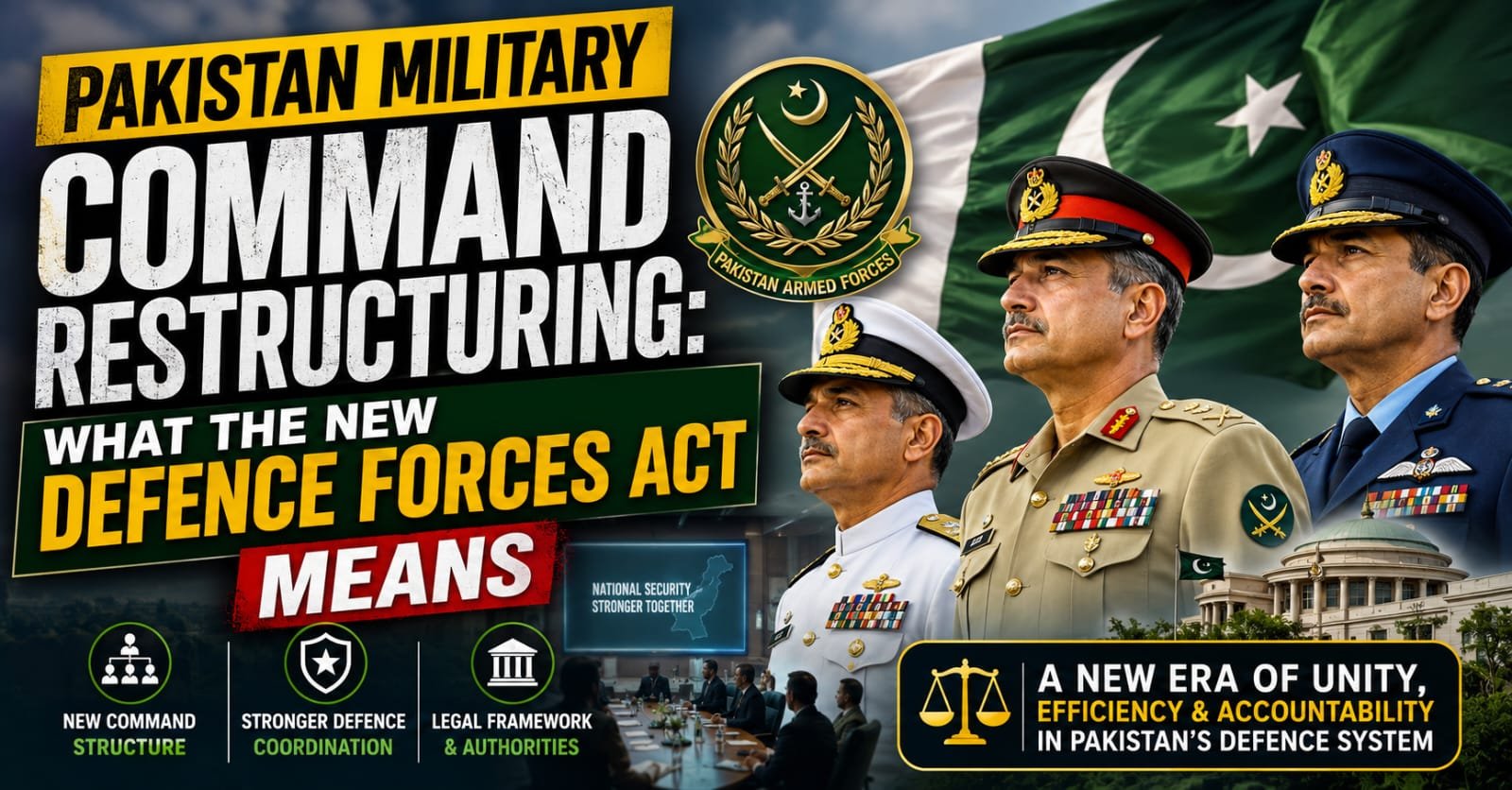
Pakistan Military Command Restructuring: What the New Defence Forces Act Means
Pakistan has just made a major change to how its military command actually works, with the approval of the Defence Forces of Pakistan Act 2026. It’s drawn a lot of attention, and for good reason — this changes how the country’s armed forces are organized right at the very top.
The centerpiece of the new structure is a brand-new position: Chief of Defence Forces, or CDF. Field Marshal Asim Munir has been named the first person to ever hold it.
People are watching this closely, viewing it as a genuinely significant shift in Pakistan’s defence administration — one that could reshape how the Army, Navy, and Air Force actually coordinate with each other going forward.
What Is the Defence Forces of Pakistan Act 2026?
The Defence Forces of Pakistan Act 2026 lays out a revised framework for the country’s senior military command structure.
Under this new setup, the Chief of Defence Forces steps into a genuinely central role in military operations and coordination. The whole point is to build a more unified command structure spanning Pakistan’s three armed services.
Before this, each service ran through its own senior commander — the Chief of Army Staff, the Chief of Naval Staff, and the Chief of Air Staff, each leading their own branch independently.
The new system leans much harder into joint coordination and unified military planning across the board.
Field Marshal Asim Munir Appointed as First CDF
Field Marshal Asim Munir has officially been named Pakistan’s first-ever Chief of Defence Forces.
His appointment carries real weight because the CDF role was specifically designed to coordinate across the Army, Navy, and Air Force — not just sit above them symbolically.
The new position hands the country’s military leadership a centralized way of coordinating major defence operations and strategic planning, something that didn’t quite exist in this form before.
Why Is the New Military Command Structure Important?
Modern military operations lean more and more on cooperation between different branches of the armed forces — that’s just the reality of how things work now.
Take a major security operation, for instance. It can call for:
- Army ground forces
- Air Force surveillance and air support
- Navy maritime capabilities
- Intelligence and communications coordination
A centralized defence command could make pulling all of that together noticeably more efficient.
People backing the restructuring argue that a unified approach can sharpen strategic planning and cut down on duplication between the different military branches.
What Changes for Pakistan’s Armed Forces?
The biggest shift here is the introduction of a senior command role that looks at the armed forces as a whole, rather than zeroing in on just one service at a time.
The Army, Navy, and Air Force will still keep their own leadership and their own day-to-day responsibilities — nothing changes there. But the new command structure is meant to tighten coordination right at the top.
That could end up mattering a lot, especially given the security challenges Pakistan’s juggling on multiple fronts at once — border security, terrorism, and regional geopolitical tensions among them.
Impact on Pakistan’s Defence Strategy
Pakistan sits in a strategically sensitive region, surrounded by a handful of major security challenges. Its defence planning has to account for conventional military threats alongside terrorism, border security, and newer technologies entering the picture.
This restructuring could give Pakistan the tools to build more integrated defence strategies going forward.
Joint planning is likely to become increasingly important in areas like:
- Cybersecurity
- Drone warfare
- Intelligence sharing
- Air defence
- Maritime security
- Modern military technology
As warfare keeps leaning harder on technology, coordination between different military branches is becoming more and more critical, not just in Pakistan but really everywhere.
What Does the New CDF Position Mean for the Future?
How much this Chief of Defence Forces position actually matters long-term really comes down to how the new command structure plays out in practice.
It has the potential to strengthen coordination between Pakistan’s armed services and give the country a clearer framework for running joint military operations.
That said, any major overhaul to a country’s military command structure needs careful, deliberate implementation. How the responsibilities get split between the CDF and the individual service chiefs will end up shaping a lot of how the whole system actually functions day to day.
Public and Political Attention
This military restructuring has stirred up plenty of political and public discussion across Pakistan.
That’s not surprising — big changes involving the armed forces almost always draw attention, given how central the military is to the country’s national security and broader strategic affairs.
Because of that, expect this new structure to stay a live topic in Pakistan’s political and defence conversations for a while yet.
Final Thoughts
Pakistan’s new military command structure marks a genuinely significant shift in how the country runs its defence administration. The creation of the Chief of Defence Forces role is meant to sharpen coordination among the Army, Navy, and Air Force while pulling national defence into a more unified approach overall.
With Field Marshal Asim Munir now serving as the first CDF, this new system marks what looks like an important chapter in Pakistan’s military organization.
Its real, lasting impact, though, will only become clear over time — as the new command structure gets implemented in full and its responsibilities get tested against actual events on the ground.