
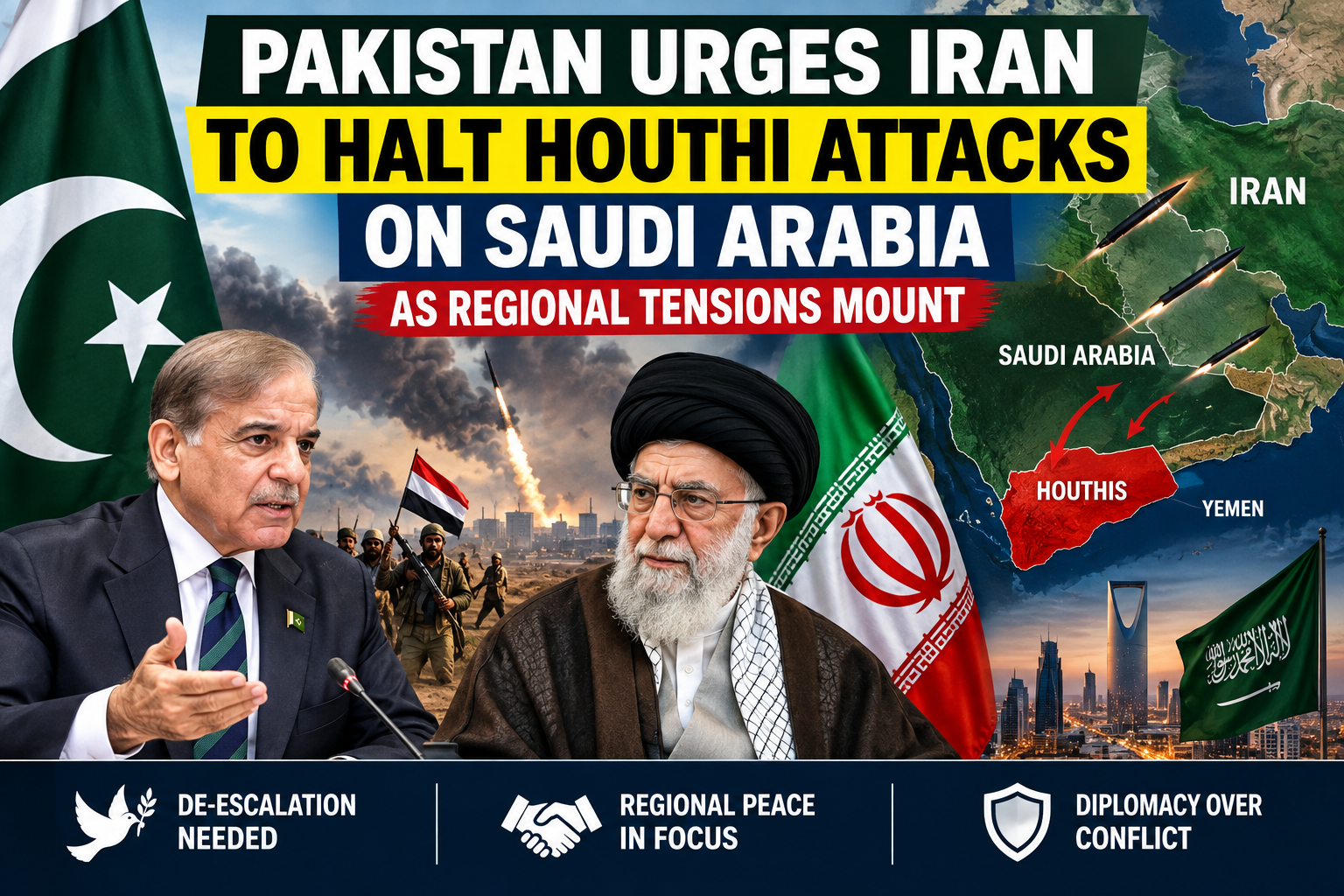
Pakistan Urges Iran To Halt Houthi Attacks On Saudi Arabia As Regional Tensions Mount
The Pakistan is ready to take diplomatic actions to prevent the worsening of the situation in the Middle East, urging Iran to cease its Houthi allies after attacks on the Saudi Arabia.
The situation is particularly worrying for the region at a crucial period, as Houthi forces continue to intensify their assaults on Saudi territory and fighting in Yemen is escalating. The situation poses potential threats to the security of the regional, oil supplies and the safety of important international shipping routes.
The Pakistan has condemned the attacks and issued a warning to Iran but also made clear that it is focussing on diplomacy rather than immediate military action.
Why Pakistan Has Warned Iran
The latest diplomatic action by Pakistan comes in the wake of an increase in Houthi attacks on Saudi Arabia.
According to reports, Houthi attacks took place in cities of Saudi Arabia and energy-related infrastructure, with 73 people reportedly injured in the recent attacks. It has resulted in renewed concerns that the conflict could spread into other regions and involve more countries directly.
Islamabad has used its diplomatic channels to call on Tehran to help in preventing further attacks.
Pakistan’s position is particularly important because the country maintains relationships with both Saudi Arabia and Iran, rather than immediately engaging one side militarily, the country has encouraged dialogue and the prevention of the crisis from blowing up into a larger regional conflict.
Pakistan Condemns the Houthi Attacks
Pakistan has strongly condemned attacks on Saudi Arabia and has expressed solidarity with the Saudi people.
Foreign Ministry spokesperson Sajjad Haider Khan said that Pakistan remains committed to its defence agreement with Saudi Arabia and Turkey, he also clarified that at present no military response under the agreement is being discussed.
This is an important distinction as previous developments had raised questions about whether Pakistan could become directly involved in the event of the fighting expanding.
For now, Islamabad looks to be focussing on diplomacy while maintaining its defence commitments.
What Is the Mecca Defence Pact?
Pakistan, Saudi Arabia and Turkey signed a joint defence agreement last month.
Under the agreement an armed attack against one of the participating countries is treated as an attack against all three of the members. The pact has become a major talking point following the latest Houthi attacks on Saudi Arabia.
However, Pakistan’s latest statement suggests that the agreement has so far not led to any discussion about a military response.
Sajjad Haider Khan said that Pakistan would act under the agreement should the circumstances require it.
Houthi Attacks Increase Regional Concerns
The latest attacks are part of a much-widening escalation in Yemen.
The Houthis have been engaged in fighting Saudi-backed Yemeni government forces and recent clashes have escalated, the Houthis have also advanced towards important areas along the Yemen’s Red Sea coast.
Reports on Thursday stated that Houthi forces had entered or captured the strategically-important port city of Mokha, located relatively close to the Bab el-Mandeb Strait, the development has raised concerns over maritime security and international trade.
The Bab el-Mandeb is an important shipping route connecting the Red Sea with the Gulf of Aden and the wider Indian Ocean.
Why Bab el-Mandeb Matters to the World
Not only is the situation a Middle Eastern security issue but it could also have consequences for global trade and energy markets.
The Bab el-Mandeb Strait is one of the world’s important maritime chokepoints and prolonged disruption could impact ships traveling between the Red Sea and the Indian Ocean.
The situation is more sensitive still due to the fact that commercial shipping is already experiencing major disruptions elsewhere in the region; the latest instability has caused concerns over oil supplies and has pushed crude prices above $100 a barrel.
If the situation continues to deteriorate, countries well outside of the Middle East could eventually be affected economically through higher transportation and energy costs.
Difficult Diplomatic Position of the Pakistan
Pakistan finds itself in a difficult diplomatic position.
Saudi Arabia is an important strategic and economic partner for Pakistan while Iran is Islamabad’s neighboring county, consequently, Islamabad has strong reasons to avoid letting tensions with either of its neighbours run out of control.
This explains why Pakistan has combined a strong condemnation of attacks on Saudi Arabia with diplomatic engagement involving Iran.
For Islamabad, the preferred outcome is to be de-escalation rather than yet another major military confrontation.
Will Pakistan Take the Military Action?
At present, Pakistan states no military response is being discussed under the Mecca defence agreement.
Foreign Ministry spokesperson Sajjad Haider Khan made the position clear during a briefing on September 10, he stated that there was no such action currently under discussion, while maintaining that Pakistan would act under the agreement should the time come.
This means that reports suggesting that Pakistan has already decided to launch military operations against the Houthis should be taken with caution.
The situation remains fluid and any decision would be dependent on the development of the conflict and whether Saudi Arabia itself faces further attacks.
Could the Conflict Spread more and Further?
The biggest concern is that the fighting could open another front in an already unstable region.
The conflict in Yemen had managed to remain more or less calm since the UN-backed ceasefire arrangements came into effect in 2022, however, recent fighting has seriously undermined that stability.
The Houthis’ advances along the Red Sea coast, Saudi military operations and continued tensions involving Iran and the United States could exacerbate the situation.
A much wider conflict could have consequences for civilians, shipping companies, energy markets and countries throughout the region.
What This Means for Pakistan
For Pakistan the immediate concern is to protect its strategic relationships while avoiding unnecessary military involvement.
Pakistan has already made its position clear that attacks on Saudi Arabia are unacceptable, but Islamabad is currently seeking a diplomatic solution.
This allows Pakistan to maintain communication with Iran while remaining in support of Saudi Arabia.
The coming days will be important because any further attacks on Saudi territory could put pressure on Islamabad to decide how far it is prepared to go under its defence commitments.
Final Thoughts
Pakistan’s warning to Iran comes at a critical moment for the Middle East.
With Houthi attacks increasing, fighting intensifying in Yemen and important Red Sea shipping routes facing new risks, the possibility of a wider regional crisis can’t be underestimated.
Now The Pakistan is asking for restraint and is pursuing diplomacy rather than the immediate military action. Islamabad has also reaffirmed its commitment to Saudi Arabia under the recently signed defence agreement.
The situation is fast-paced and the next developments in Yemen, Saudi Arabia and Iran will be important in determining whether tensions start to ease or move towards a much wider confrontation.