
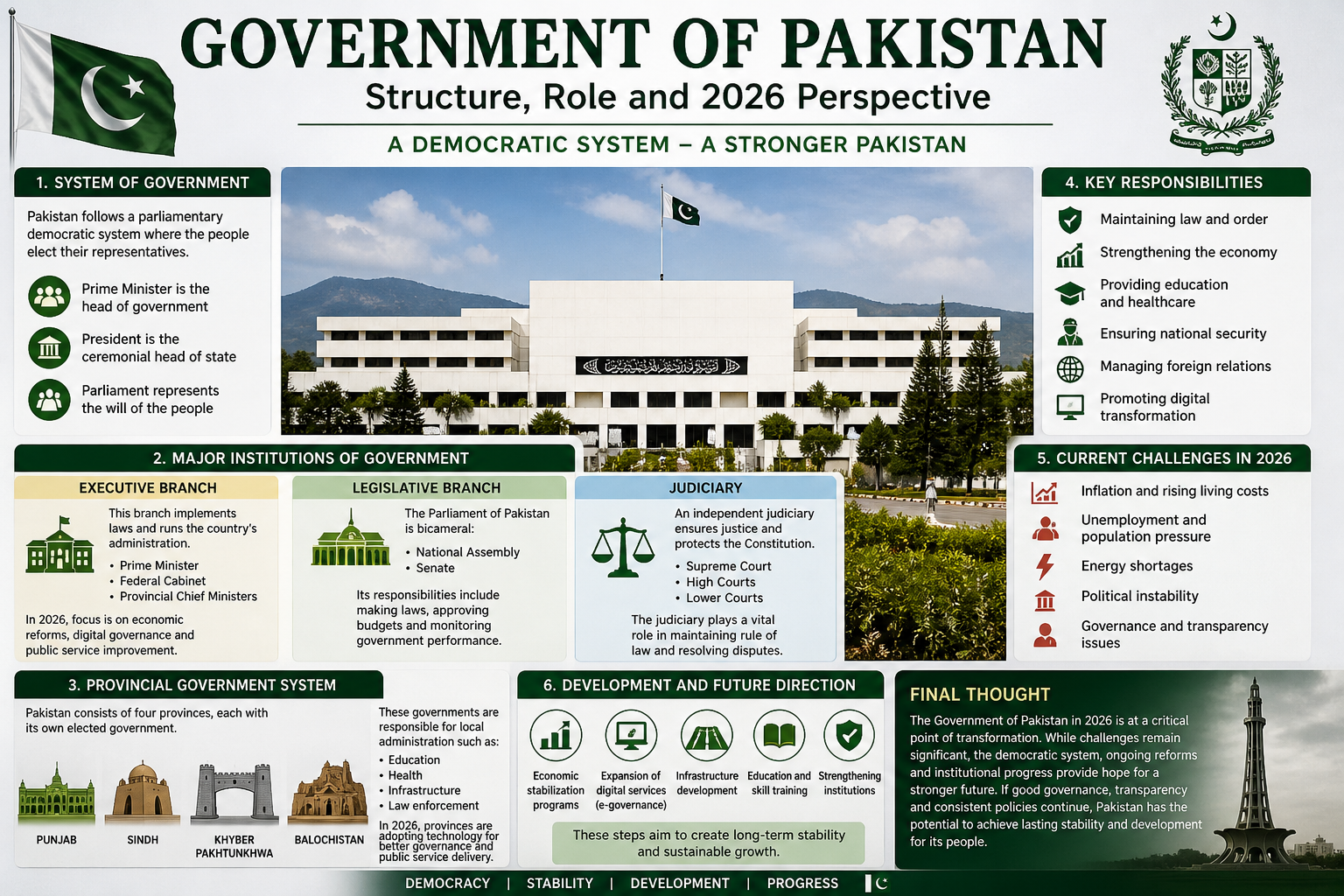
Pakistan is a federal parliamentary republic that operates under the Constitution of 1973. In 2026, the country continues to evolve politically, economically, and administratively while maintaining a democratic system based on elected representation.
The government’s main goal is to ensure stability, development, and welfare for its citizens through effective governance and institutional balance.
1. System of Government
Pakistan follows a parliamentary democratic system, where the people elect their representatives through general elections.
- The Prime Minister is the head of government and holds executive authority
- The President is the ceremonial head of state
- Parliament represents the will of the people
This system ensures that power remains with elected representatives rather than individuals.
2. Major Institutions of Government
The government is divided into three key institutions:
Executive Branch
This branch implements laws and runs the country’s administration. It includes:
- Prime Minister
- Federal Cabinet
- Provincial Chief Ministers
In 2026, the executive focuses heavily on economic reforms, digital governance, and public service improvement.
Legislative Branch
The Parliament of Pakistan is bicameral:
- National Assembly
- Senate
Its responsibilities include making laws, approving budgets, and monitoring government performance.
Judiciary
An independent judiciary ensures justice and protects the Constitution:
- Supreme Court
- High Courts
- Lower Courts
The judiciary plays a vital role in maintaining rule of law and resolving constitutional matters.
3. Provincial Government System
Pakistan consists of four provinces:
- Punjab
- Sindh
- Khyber Pakhtunkhwa
- Balochistan
Each province has its own elected government responsible for local administration such as:
- Education
- Health
- Infrastructure
- Law enforcement
In 2026, provincial governments are increasingly adopting technology for better governance and public service delivery.
4. Key Responsibilities of Government
The government plays an essential role in:
- Maintaining law and order
- Strengthening the economy
- Providing education and healthcare
- Ensuring national security
- Managing foreign relations
- Promoting digital transformation
5. Current Challenges in 2026
Despite progress, Pakistan continues to face several challenges:
- Inflation and rising living costs
- Unemployment and population pressure
- Energy shortages
- Political instability
- Governance and transparency issues
However, reforms, foreign investments, and digital initiatives are helping to improve the situation gradually.
6. Development and Future Direction
In 2026, Pakistan is focusing on:
- Economic stabilization programs
- Expansion of digital services (e-governance)
- Infrastructure development
- Education and skill training
- Strengthening institutions
These steps aim to create long-term stability and sustainable growth.
Final Thought
The Government of Pakistan in 2026 is at a critical point of transformation. While challenges remain significant, the democratic system, ongoing reforms, and institutional progress provide hope for a stronger future. If good governance, transparency, and consistent policies continue, Pakistan has the potential to achieve lasting stability and development for its people.