
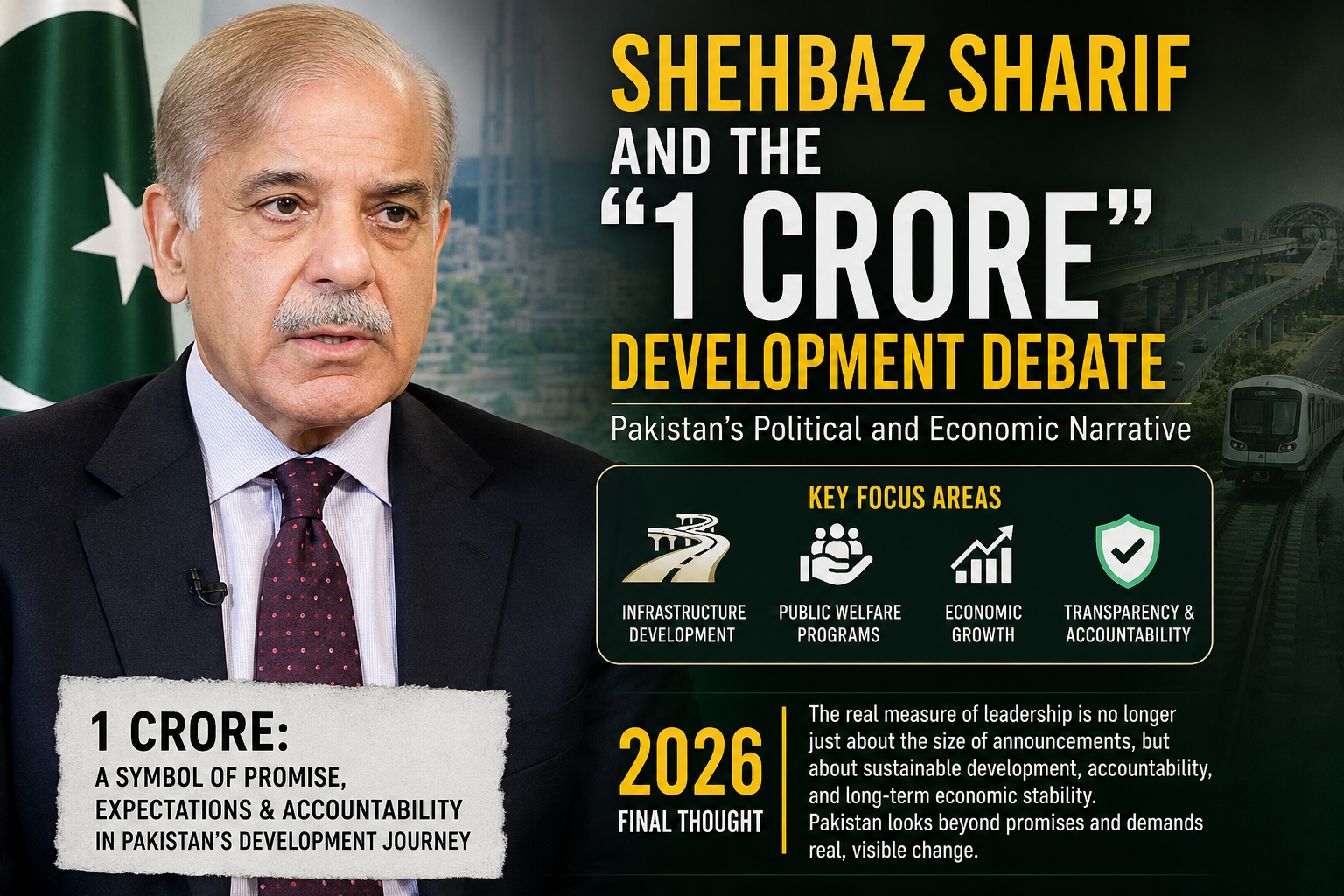
In Pakistan’s modern political discourse, numbers often become symbols of larger debates. One such emerging reference is the “1 Crore” narrative associated in public discussion with development plans, governance decisions, and financial allocations linked to the leadership of Shehbaz Sharif. While the figure itself is frequently used in different contexts by media, critics, and supporters, it has grown into a broader metaphor for economic promises and development expectations in Pakistan.
This article explores the meaning behind such narratives, the governance style of Shehbaz Sharif, public perception, and the overall political-economic environment of Pakistan leading into 2026.
Political Background and Leadership Style
Shehbaz Sharif has served multiple times in senior political positions in Pakistan, including Chief Minister of Punjab and Prime Minister. Over his political career, he has built a reputation centered on infrastructure development, rapid project execution, and administrative control.
Supporters often describe his leadership style as “performance-driven,” highlighting projects related to roads, metro systems, energy initiatives, and urban development. His governance model has typically focused on visible development projects aimed at improving infrastructure and public facilities.
However, critics argue that while infrastructure projects are visible, issues such as long-term economic stability, debt management, and institutional reform require deeper structural changes beyond physical development.
The “1 Crore” Narrative in Public Debate
The phrase “1 Crore” in political discussions is often symbolic rather than literal. In Pakistan’s political environment, large financial figures are commonly used to represent budgets, welfare schemes, or development allocations.
In public discourse connected to Shehbaz Sharif’s governance style, “1 Crore” has become a shorthand expression used by commentators and citizens to question or highlight:
- Development fund allocations
- Local government project budgets
- Welfare program spending
- Public promises versus actual delivery
This figure is not tied to a single confirmed national policy but rather reflects how political communication and public interpretation blend together in Pakistan’s media environment.
Development vs. Reality: Public Expectations
Pakistan is a developing country facing complex challenges, including inflation, population growth, energy shortages, and unemployment. In such an environment, public expectations from political leadership are extremely high.
During Shehbaz Sharif’s leadership periods, several development projects have been launched with the aim of improving infrastructure and economic activity. These include road networks, public transport systems, and urban modernization programs.
Supporters argue that these initiatives help improve daily life, reduce travel time, and support economic activity. They view large-scale spending as necessary for a growing country.
However, public criticism often focuses on the gap between announcements and ground-level impact. Citizens frequently question whether financial allocations—symbolically referred to in debates like “1 Crore projects”—actually reach communities in a meaningful way.
Economic Challenges Leading into 2026
By 2026, Pakistan’s economy continues to face structural challenges. Inflation, foreign debt pressure, energy costs, and unemployment remain key concerns for policymakers.
In this context, development spending becomes both necessary and controversial. Governments must balance between:
- Infrastructure expansion
- Social welfare programs
- Debt repayment obligations
- Currency stabilization efforts
The discussion around “large figures” in politics reflects the tension between ambition and fiscal reality.
Media Influence and Public Interpretation
In today’s digital age, political narratives spread quickly through social media platforms. Numbers like “1 Crore” can easily become viral symbols without full context.
This often leads to:
- Misinterpretation of budget figures
- Political polarization
- Simplification of complex economic policies
- Emotional public reactions
As a result, leadership figures like Shehbaz Sharif often find themselves at the center of debates where symbolic numbers represent broader dissatisfaction or support.
Governance Achievements and Criticism
Achievements often highlighted:
- Rapid infrastructure development projects
- Focus on urban transport systems
- Administrative efficiency in provincial governance
- Emphasis on visible public service improvements
Common criticisms:
- Long-term sustainability of projects
- Debt and fiscal pressure concerns
- Uneven development between urban and rural areas
- Questions about transparency and accountability
These contrasting perspectives shape the ongoing political debate around his leadership style.
The Role of Public Accountability in 2026
As Pakistan moves deeper into 2026, citizens are increasingly demanding accountability beyond political slogans and financial figures. The focus is shifting from “how much is being spent” to “how effectively it is being used.”
This shift reflects a maturing political awareness where voters evaluate:
- Education quality improvements
- Healthcare accessibility
- Employment generation
- Cost of living changes
- Governance transparency
In this environment, symbolic references like “1 Crore” become less important than measurable outcomes.
Final Thought – 20026
The debate around Shehbaz Sharif and the so-called “1 Crore” narrative highlights a larger truth about Pakistan’s political system: numbers alone do not define progress. While financial allocations and development budgets are important, the real measure of leadership in 2026 lies in sustainable economic reform, institutional strength, and tangible improvement in citizens’ lives.