Solar Panel Prices in Pakistan
Solar Prices in Pakistan Fall Again: Panels and Inverters Become Cheaper for Common People
By News Desk – 7 November 2026
Good news has finally come for the people of Pakistan who were tired of high electricity bills. Solar panel prices in Pakistan have fallen again. After many months of ups and downs, the market is now showing a clear drop in prices. Dealers in Lahore, Karachi, Peshawar, and Multan are all saying the same thing. Solar is now cheaper than before, and this is the best time to buy if you were waiting.
For a common family, this is a big relief. Electricity in Pakistan has become very expensive. Every month, people get a bill that is hard to pay. Many families are now thinking about solar as a permanent solution. And now, with prices going down, that dream is becoming possible for more people.
What is the Latest Solar Panel Price in Pakistan Today?
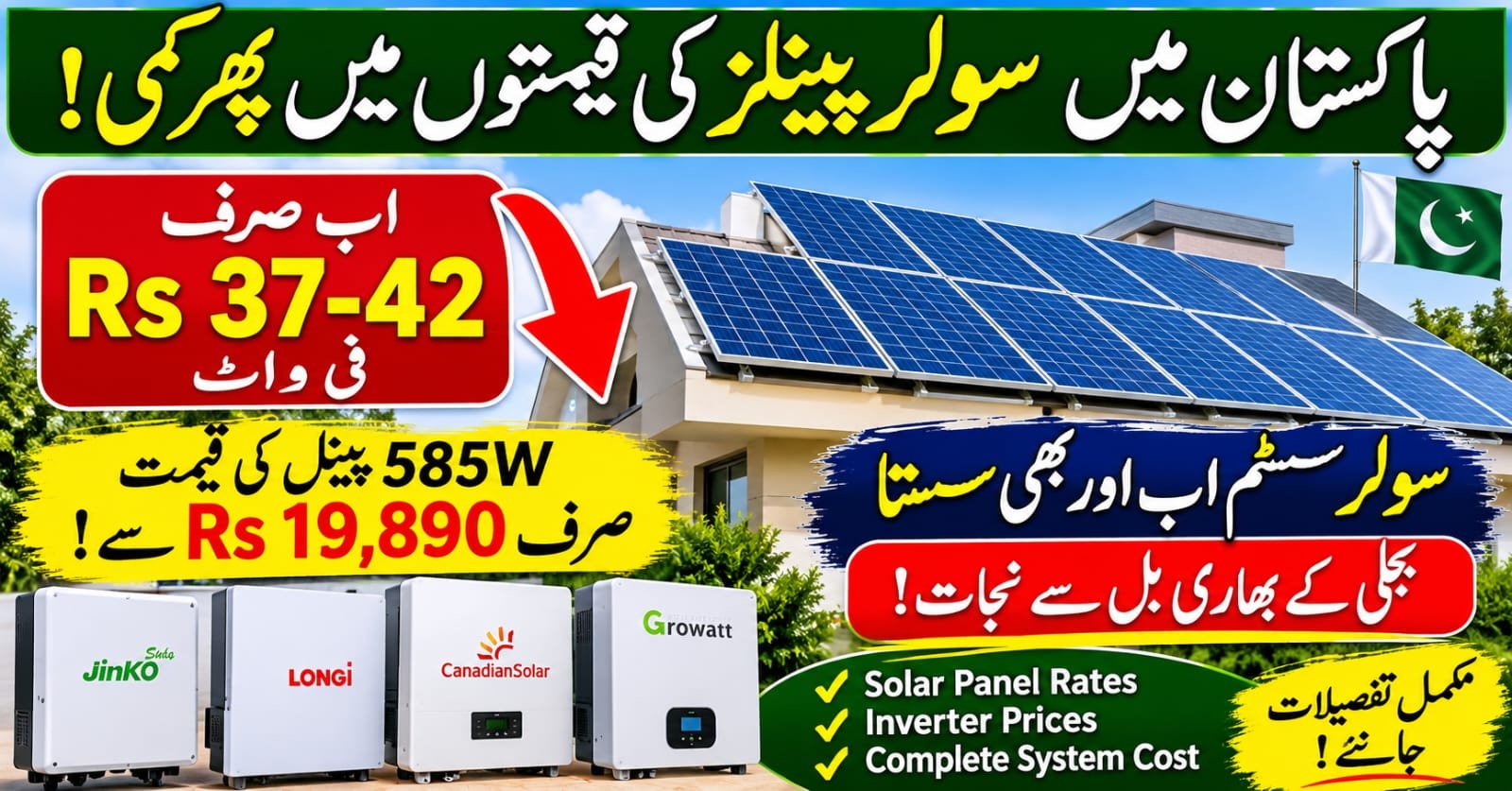
On 7 November 2026, the average price of a solar panel in Pakistan is between Rs 37 to Rs 42 per watt. This is for good quality, A-Grade, Tier-1 panels. A few weeks ago, the same panels were selling for Rs 46 to Rs 50 per watt. So there is a clear difference.
If we talk about one plate, the most popular plate in Pakistan right now is the 585 watt plate. Almost every house uses this plate. Today, a 585 watt plate is available for Rs 19,890 to Rs 25,500, depending on the brand.
Some cheap brands are even lower. For example, Ronma and Jesko 585 watt plates are selling for around Rs 19,890. These are for people who have a low budget and just want to run fans and lights.
On the other hand, big brands like Jinko, Longi, Canadian Solar, and JA Solar are a little more expensive, but people trust them more because of their long life and good warranty.
Here is a simple breakdown of today’s rates:
JA Solar 585W: Rs 21,350 to Rs 21,937
Jinko Solar 585W: Rs 22,600 to Rs 22,961
Canadian Solar 585W: Rs 23,400 to Rs 23,692
Longi Hi-Mo 7 585W: Rs 23,985 to Rs 25,008
Longi Hi-Mo X10 645W: Rs 26,500 to Rs 28,218
These prices are for the panel only. They do not include inverter, stand, wires, and fitting charges. Still, compared to last year, the panel price has dropped by almost 30 to 40 percent. Last year, a 585 watt plate was selling for Rs 32,000 to Rs 35,000. Today, the same plate is available for under Rs 26,000.
Dealers say there are two main reasons for this drop. First, the international price of solar cells has gone down. China, which makes most of the world’s panels, has increased production. When supply goes up, price comes down. Second, the dollar rate in Pakistan has become a little stable. Since panels are imported in dollars, a stable dollar means a stable and low price.
City Wise Difference in Prices
Prices are not the same in every city. In Karachi, prices are the lowest because panels come directly from the port. In Lahore, prices are also low because there is a big market and many dealers are competing.
In Peshawar, the price is a little higher. For example, in Peshawar today, a good Tier-1 panel is selling for Rs 41 to Rs 45 per watt. The reason is transport cost from Karachi and Lahore to Peshawar. In Mansehra, Abbottabad, and other small cities, the price can be Rs 1 to Rs 2 per watt higher than Lahore.
But still, even with this small difference, the overall trend is downward in every city.
Now Let’s Talk About Inverter Prices
A solar system is incomplete without an inverter. The panel makes DC electricity, and the inverter changes it into AC electricity, which we use in our homes. Many people only ask about panel prices, but inverter price is also very important.
In Pakistan, there are two types of inverters that are most popular. One is the on-grid inverter, which works with WAPDA and net metering. The other is the hybrid inverter, which works with batteries and can give you electricity even when there is load shedding.
Here are the latest inverter prices in Pakistan on 7 November 2026:
1. Small System Inverters – For 1 to 3 kW
If you want to run only 2-3 fans, a few lights, and a fridge, a small inverter is enough.
- Inverex 1.2 kW: Rs 65,000 to Rs 75,000
- Fronus 2 kW: Rs 70,000 to Rs 85,000
- Tesla 3 kW Hybrid: Rs 125,000 to Rs 145,000
These are good for a small house or a shop.
2. Medium System Inverters – For 5 kW to 6 kW
This is the most popular size in Pakistan. Most families install a 5 kW or 6 kW system. It can run a full house, including AC, fridge, water motor, and fans.
- Inverex Nitrox 5 kW Hybrid: Rs 285,000 to Rs 310,000
- Inverex Nitrox 6 kW Hybrid: Rs 330,000 to Rs 360,000
- Growatt 5 kW On-Grid: Rs 195,000 to Rs 220,000
- Sungrow 5 kW On-Grid: Rs 210,000 to Rs 235,000
- Huawei 5 kW On-Grid: Rs 245,000 to Rs 270,000
Hybrid inverters are more expensive than on-grid inverters because they can work with batteries. But people prefer hybrid because of load shedding.
3. Big System Inverters – For 10 kW and Above
For a big house, plaza, or factory, people use 10 kW or 15 kW inverters.
- Inverex Nitrox 10 kW Hybrid: Rs 550,000 to Rs 600,000
- Growatt 10 kW On-Grid: Rs 330,000 to Rs 365,000
- Huawei 10 kW On-Grid: Rs 410,000 to Rs 450,000
- Sungrow 15 kW On-Grid: Rs 480,000 to Rs 520,000
Dealers say inverter prices have also come down a little, but not as much as panels. The reason is that inverters have more electronic parts and their demand is still high.
What is the Total Cost of a Full Solar System?
Many people ask, “If I install solar, how much will it cost in total?”
Let’s make it simple. For a normal house in Pakistan:
3 kW System – For Small House:
You will need 6 plates of 585W. Panel cost will be around Rs 135,000. Inverter will be around Rs 140,000. Stand, wires, breaker, and fitting will be around Rs 90,000. Total cost will be around Rs 365,000 to Rs 400,000. This system can run fans, lights, fridge, and one small AC.
5 kW System – For Medium House:
You will need 9 to 10 plates. Panel cost will be around Rs 230,000. Inverter will be around Rs 300,000. Other material and fitting will be around Rs 150,000. Total cost will be around Rs 650,000 to Rs 720,000. This system can easily run a full house with 1.5 ton AC.
10 kW System – For Big House:
You will need 18 plates. Panel cost will be around Rs 450,000. Inverter will be around Rs 550,000. Other material will be around Rs 250,000. Total cost will be around Rs 1,200,000 to Rs 1,350,000. This system can run 2-3 ACs, full house load, and you can also sell extra electricity to WAPDA through net metering.
If you add batteries, the cost will increase. One lithium battery of 5 kW costs around Rs 265,000 to Rs 350,000. But many people are not buying batteries now because they are using net metering. With net metering, you give extra electricity to WAPDA in the day and take it back at night.
What Are People Saying in the Market?
We talked to some shopkeepers and buyers in Lahore and Peshawar. Muhammad Imran, a dealer in Lahore, said, “Customers are coming back. For two months, people were waiting because they thought prices would fall more. Now prices have fallen, so people are buying.”
A buyer from Mansehra, who came to Peshawar to buy panels, said, “My electricity bill was Rs 28,000 per month. Now I am installing a 5 kW system. I hope my bill will become zero.”
This is the story of thousands of families in Pakistan. They are tired of expensive bills and load shedding. Solar is giving them freedom.
Should You Buy Now or Wait More?
This is the question everyone is asking. Experts say prices may fall a little more, but not by a big amount. The price is already very low. If you wait for Rs 1 or Rs 2 more drop, you will lose 2-3 months of free electricity from solar. So if you have the money, this is a good time to buy.
But one important advice is to always buy A-Grade, documented panels. Many cheap, B-Grade panels are also in the market. They look the same, but their performance is very bad. They stop working after 1-2 years. Always ask for warranty card, original packing, and dealer bill.
Also, do not buy from unknown sellers on Facebook or WhatsApp only. Go to a proper shop, check the panel, and then buy.
Final Thought
Solar in Pakistan is no longer a luxury for rich people. It has become a need for every common family. With panel prices at Rs 37 to Rs 42 per watt and a 585W plate available for under Rs 26,000, solar is now within reach.
The government should also support this trend. If net metering becomes easy and bank loans become available for solar, millions of more houses will shift to solar. This will not only help families save money, but it will also help Pakistan reduce load shedding and save foreign exchange that we spend on fuel.
For a common man, the message is simple. Do not be afraid of the one-time cost. Think about the next 25 years. A solar system can work for 25 years. If you spend Rs 700,000 today on a 5 kW system, you will save almost Rs 30,000 every month. That means your money will come back in just 2 years. After that, your electricity will be almost free for the next 23 years.
That is why today, solar is not just a choice. It is the smartest decision a Pakistani family can make.