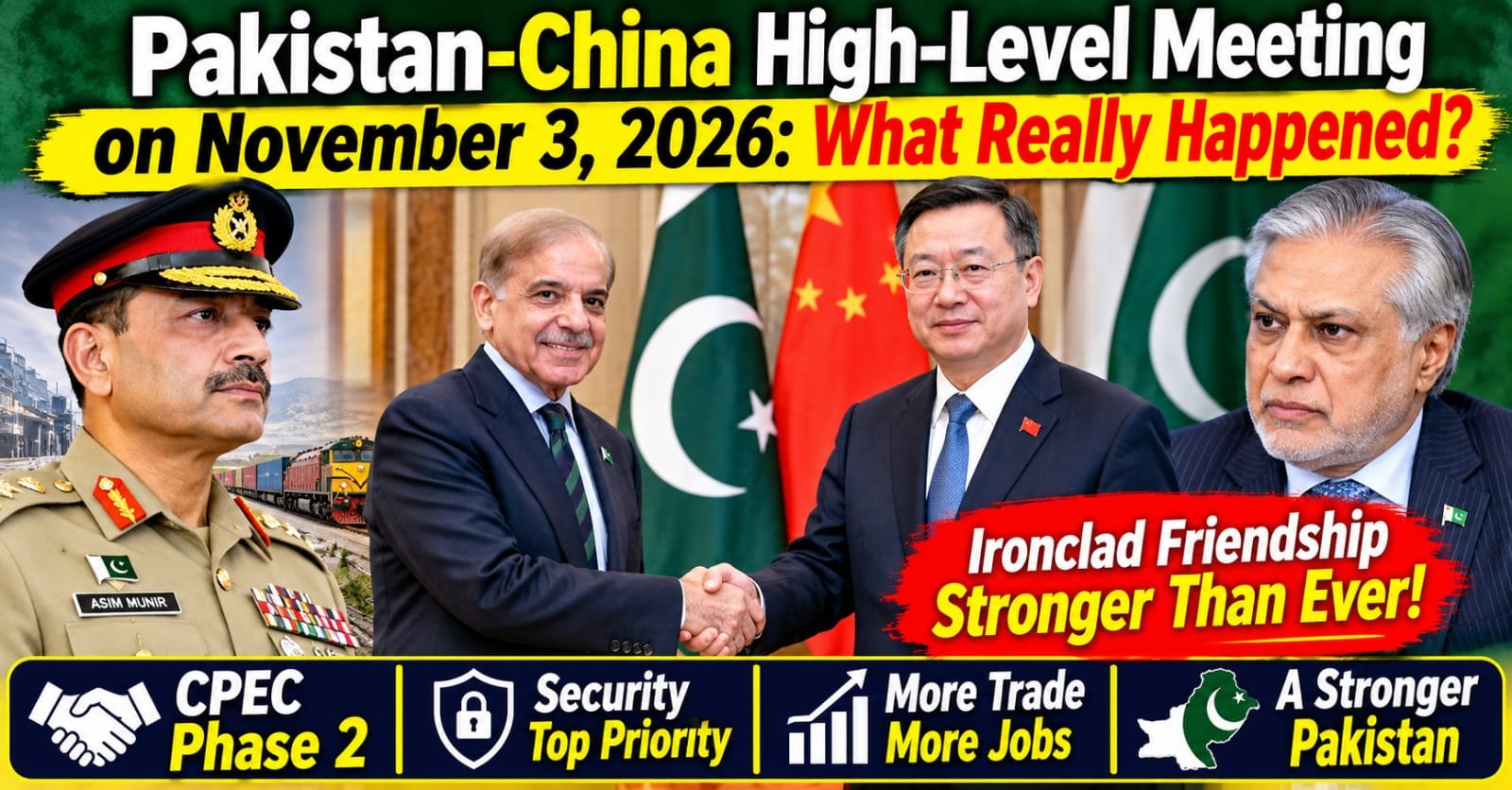
If you follow Pakistan’s news, you know one thing for sure — whenever things get tough, China is the first country Pakistan calls, and vice versa. Something similar happened on November 3, 2026, in Islamabad.
It was not just a handshake and photo session. It was a serious, high-level meeting. And it tells us a lot about where Pakistan is heading.
Let me break it down for you in simple words.
So, Who Actually Came From China?
The man who came is not a small name. His name is Liu Haixing. He is a minister in the International Department of the Communist Party of China — in short, IDCPC.
Now, in China, the Communist Party runs everything. So if their International Department’s minister comes himself to Pakistan, it is a big deal. It means Beijing is taking Pakistan seriously.
He landed in Islamabad on Sunday night, November 2nd, with his full team. His visit is for three days. And this is his main visit to Pakistan this year.
What Happened With PM Shehbaz Sharif?
On Monday morning, Liu Haixing went to meet Prime Minister Shehbaz Sharif.
Shehbaz Sharif used a phrase that we have all heard before, but this time he said it with more weight. He said Pakistan and China have an “ironclad, time-tested, all-weather friendship.”
What does that even mean? Ironclad means you can’t break it. All-weather means it doesn’t matter if it’s a good day or a bad day, we are together. Whether it is floods, debt crisis, or political pressure — both sides stand together.
Shehbaz also said thank you to China. Because let’s be honest, in the last two years when Pakistan’s economy was in real trouble, China was the one that rolled over loans and kept supporting us. He also said CPEC is the heart of this friendship.
Liu Haixing replied in a very positive way too. He said Pakistan is China’s most reliable partner in this whole region. And China wants to do more — more trade, more security work, more development.
Then He Met Field Marshal Asim Munir — And This Was Important
After the PM, the Chinese delegation met Chief of Defence Forces, Field Marshal Asim Munir. This meeting was all about security.
ISPR, which is our army’s media wing, said they talked about “regional and global security situation and bilateral relations.”
In plain language — they talked about Afghanistan. They talked about what’s happening on the India border. They talked about the Middle East. And most importantly, they talked about the safety of Chinese people working in Pakistan.
You know, last year we had some very sad incidents where Chinese engineers working on CPEC were attacked. China is obviously worried about that. Pakistan Army knows it. So Field Marshal Asim Munir reportedly assured them that the security of Chinese nationals is now a top priority. No compromise.
This tells you that the army-to-army relationship is just as strong as the government-to-government one. China still gives Pakistan most of its defence equipment.
A Separate Meeting With Ishaq Dar
Liu Haixing also sat down with Deputy PM and Foreign Minister Ishaq Dar. This one was more about foreign policy and money.
Ishaq Dar repeated that Pakistan supports One China Policy — meaning we believe Taiwan is part of China. And China, as always, supports Pakistan on Kashmir.
They also talked about trade, which is a big headache right now. We buy a lot from China, but we sell very little to them. That trade gap is huge. Both sides agreed they need to fix it. China said it will try to buy more Pakistani rice, mango, and textiles. Let’s see if it actually happens.
But Why Now? Why This Meeting in November?
Nothing happens without timing. There are four reasons this meeting is happening right now:
- Security. Things in KP and Balochistan are not stable. Militancy has increased. That directly threatens CPEC roads and workers.
- Money. Pakistan needs money. We need China to roll over some debt again, and we need Phase 2 of CPEC to finally start. Phase 1 was roads and power plants. Phase 2 is supposed to be factories, farming, and IT jobs.
- World politics. America is making new friends in Asia — India, Philippines, Japan. China does not want to lose its old friend Pakistan.
- CPEC is slow. Honestly, CPEC has become a bit slow in the last one year. Projects like the ML-1 railway line — the big train line from Karachi to Peshawar — are stuck. Both sides want to push it forward.
So Liu’s visit is basically to say — look, we are still together, let’s clear the air and move forward.
So What Was Decided Behind Closed Doors?
Official statements are always very formal. But if you read between the lines, this is what was likely agreed:
First, start ML-1 and Gwadar industrial zone work faster.
Second, make a better security plan for Chinese staff in Pakistan.
Third, bring more Chinese private companies to invest in solar and electric cars in Pakistan. That’s a huge market right now.
Fourth, stay together on big world issues like Palestine, Kashmir, and Afghanistan at the UN.
What Does It Mean For Normal People Like Us?
You might think — okay, big leaders met, so what? How does it help me?
It does, actually.
If CPEC Phase 2 really starts, there will be jobs. Factories need workers. It means jobs for engineers, electricians, drivers, and even daily wage workers.
If China helps in agriculture, our farmers could get better seeds and machines. That means better crop.
If trade increases, things like solar panels, which are already popular in Pakistan, could get cheaper.
And if security cooperation gets better, maybe, just maybe, the security situation in Balochistan and KP will get better too.
Final Thought
Look, we have heard the words “Pak-China friendship higher than Himalayas” since we were kids. Sometimes it feels like just a slogan.
But when you see a meeting like this on November 3, 2026 — with PM Shehbaz Sharif, Field Marshal Asim Munir, and a top Chinese minister sitting together and talking about real problems — you realize it is more than a slogan.
For over 70 years, this friendship has survived wars, sanctions, economic crises, and changes of government. Other countries change their friends depending on their interest. Pakistan and China have not.
In a world that is getting more divided every day, this meeting is a clear signal to everyone: Islamabad and Beijing are still walking side by side.
And for ordinary Pakistanis, that is not just politics. It is hope — hope for jobs, hope for stability, and hope that someone is still willing to invest in our future.