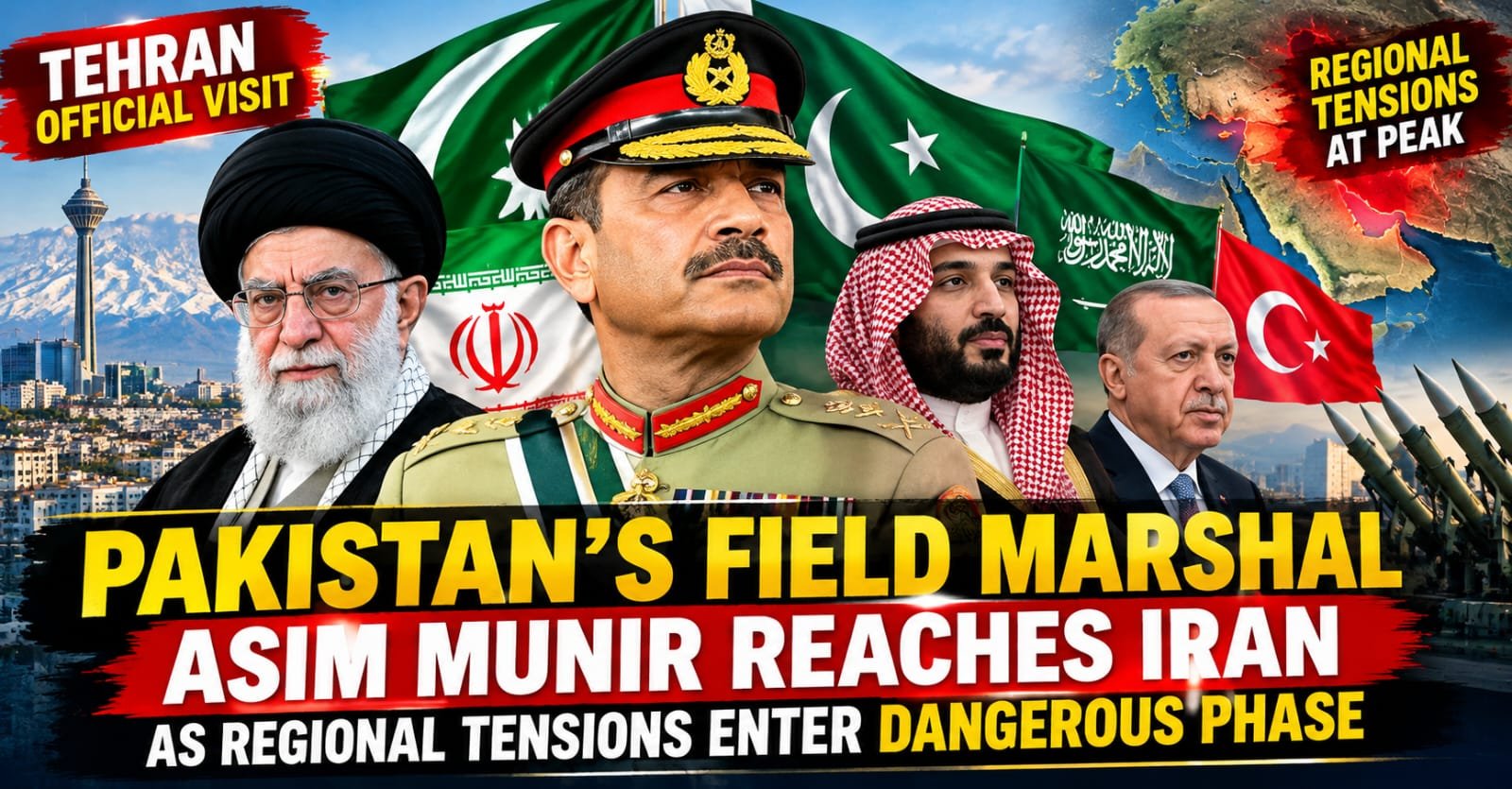
TEHRAN – Pakistan’s Chief of Defence Forces and Chief of Army Staff, Field Marshal Syed Asim Munir, arrived in Tehran on Monday for an official visit that is being seen as one of the most sensitive diplomatic missions in the region in recent months.
According to Iranian state media IRNA, Field Marshal Munir is heading a delegation of Pakistani officials and arrived in Tehran on Monday afternoon. The Inter-Services Public Relations (ISPR) also confirmed that the Chief of Defence Forces is visiting Tehran for an official visit. f8b93cc1
This is not a routine bilateral visit. It is his fifth visit to Iran in recent months, but this time the timing and the company he is keeping makes it very different.
A Four-Country Meeting In Tehran
The main focus of this visit is a joint meeting that Pakistan itself proposed. Iranian Foreign Ministry spokesperson Esmaeil Baghaei said that Field Marshal Munir “has proposed holding a four-country meeting” and that Iran agreed to it following his proposal. 3cc1
That meeting is now happening. According to IRNA and Reuters, top officials from Saudi Arabia, Turkey and Pakistan will meet Iranian leaders in Tehran on Monday.
Saudi Arabia will be represented by Defence Minister Prince Khalid bin Salman, Pakistan by army chief Field Marshal Asim Munir, and Turkey by intelligence chief Ibrahim Kalin, officials said on condition of anonymity. ce41
The Deputy Secretary of Iran’s Supreme National Security Council, Ali Bagheri, announced that these senior officials will travel to Tehran as part of efforts to implement the idea of “endogenous security” in West Asia. 3cc1
In simple words, endogenous security means that the security of this region should be handled by the countries of this region, not by outside powers like the US and Israel. This idea has become very important after the war that started in February.
Why This Visit Is So Critical Right Now
Two major developments are happening at the same time.
First, Pakistan-Iran border was reopened on Tuesday as Field Marshal Munir held talks with Iran’s leadership. An official familiar with the visit told The Express Tribune that the talks went “very well”. The border had been facing issues due to security concerns and smuggling, but now it has been resolved after discussions. 913d
Second, and more dangerous, Yemen’s Iran-aligned Houthis have started attacking Saudi Arabia again. They have been targeting Saudi energy, airport and other infrastructure.
This puts Pakistan in a very difficult position. Pakistan has signed the Makkah Joint Defence Agreement with Saudi Arabia and Turkey. Under this agreement signed in August, an armed attack on one member is considered an attack on all. The sources said Pakistan has pledged to defend Saudi Arabia under this pact. ce41913d
At the same time, Pakistan is trying to maintain close engagement with Tehran and attempting to revive stalled Iran-US diplomacy.
Pakistani government sources told Anadolu news agency that Field Marshal Munir’s latest meetings with the Iranian leadership were more focused on the Houthi attacks on Saudi Arabia. He reportedly urged the Iranian leadership to use its influence to bring a halt to Houthi attacks on Saudi Arabia, explaining Pakistan’s commitment to defend the kingdom under the Mecca defense pact. 96a9
Pakistan’s Role As Mediator
Since the conflict between US, Israel and Iran began, Pakistan has been playing a central role in mediation. Field Marshal Munir, along with Prime Minister Shehbaz Sharif and Deputy Prime Minister Ishaq Dar, has been playing a central role in mediation efforts between Iran and the United States. f8b9
In June, Pakistan and Qatar helped broker a short-lived memorandum of understanding, which Tehran insists should still form the basis of any peace deal.
Iran’s ambassador to Pakistan, Reza Amiri Moghadam, said on Saturday that Iran remains open to talks with the US under a Pakistan-brokered interim deal reached in June. He said that Iranian officials had conveyed their willingness to reopen the Strait of Hormuz during Field Marshal Munir’s visits to Tehran, provided Washington ended its blockade. a1db
The Strait of Hormuz is the world’s most important oil route. If Iran blocks it, oil prices around the world will shoot up. So this is not just a Middle East issue, it affects every common man.
On this visit, Field Marshal Munir met Iranian President Masoud Pezeshkian, Parliament Speaker Mohammad Bagher Ghalibaf, Foreign Minister Abbas Araghchi and General Mohsen Rezaei, representative of Iran’s Supreme Leader. Interior Minister Mohsin Naqvi also accompanied him. 913df8b9
According to Iranian foreign ministry spokesperson, talks will focus primarily on bilateral relations, regional developments, easing regional tensions, and various international issues. f8b9
The Bigger Picture: US, Israel and Iran
This meeting comes at a time when rhetoric between Washington and Tehran has grown more heated. Both countries have also drawn up plans to restart the wider war, possibly after the US midterm elections on November 3. ce41
Iranian Foreign Ministry spokesperson said on Monday that discussions on regional security would include “Israel’s expansionist policies, developments in the Palestinian territories and Lebanon, and the repercussions of US and Israeli military action against Iran”. ce41
For Pakistan, the challenge is to balance everything. It cannot leave Saudi Arabia alone because of religious and defence ties. It cannot leave Iran alone because it is a direct neighbour and shares a 900 km border. And it cannot ignore the US because of global politics. That is why Field Marshal Munir is going back and forth.
Some reports claimed Iran gave a cold shoulder in the last visit, but this time the tone seems different. The border reopening and the acceptance of the four-country meeting proposal shows Tehran is willing to listen.
What Happens Next
The joint meeting in Tehran today with Saudi Defence Minister, Turkish intelligence chief and Pakistan’s Field Marshal is the first high-level contact between Iran and all members of the three-nation bloc since Saudi Arabia was drawn deeper into the conflict. ce41
The talks aim to reduce regional tensions, consider new regional security arrangements and explore diplomatic options to prevent a possible new military confrontation between Iran, the United States and Israel. 7672
If this meeting succeeds, it could prevent a new regional war that many fear.
Final Thought
This is not just a military visit. This is Pakistan trying to do what very few countries can do right now – talk to everyone at the same time.
Saudi Arabia trusts Pakistan because of defence agreements and decades of brotherhood. Iran trusts Pakistan because Pakistan did not join any anti-Iran alliance and kept its border open for dialogue. Turkey trusts Pakistan as a strategic partner. And the US also uses Pakistan’s back channel to talk to Iran.
Field Marshal Asim Munir reaching Iran today shows that Pakistan does not want war in the region. It wants a solution where Muslims countries solve their own problems without waiting for Washington or Tel Aviv to decide their future.
Whether Iran can control the Houthis, whether Saudi Arabia can show restraint, and whether the US will lift the blockade on the Strait of Hormuz – all these questions will be answered in the next few days.
But one thing is clear: if peace has any chance in this region, it will come through meetings like this in Tehran, not through missiles. And for a common Pakistani or Iranian citizen who just wants cheap oil, open borders and no war, this visit is a small hope in a very dark time.