
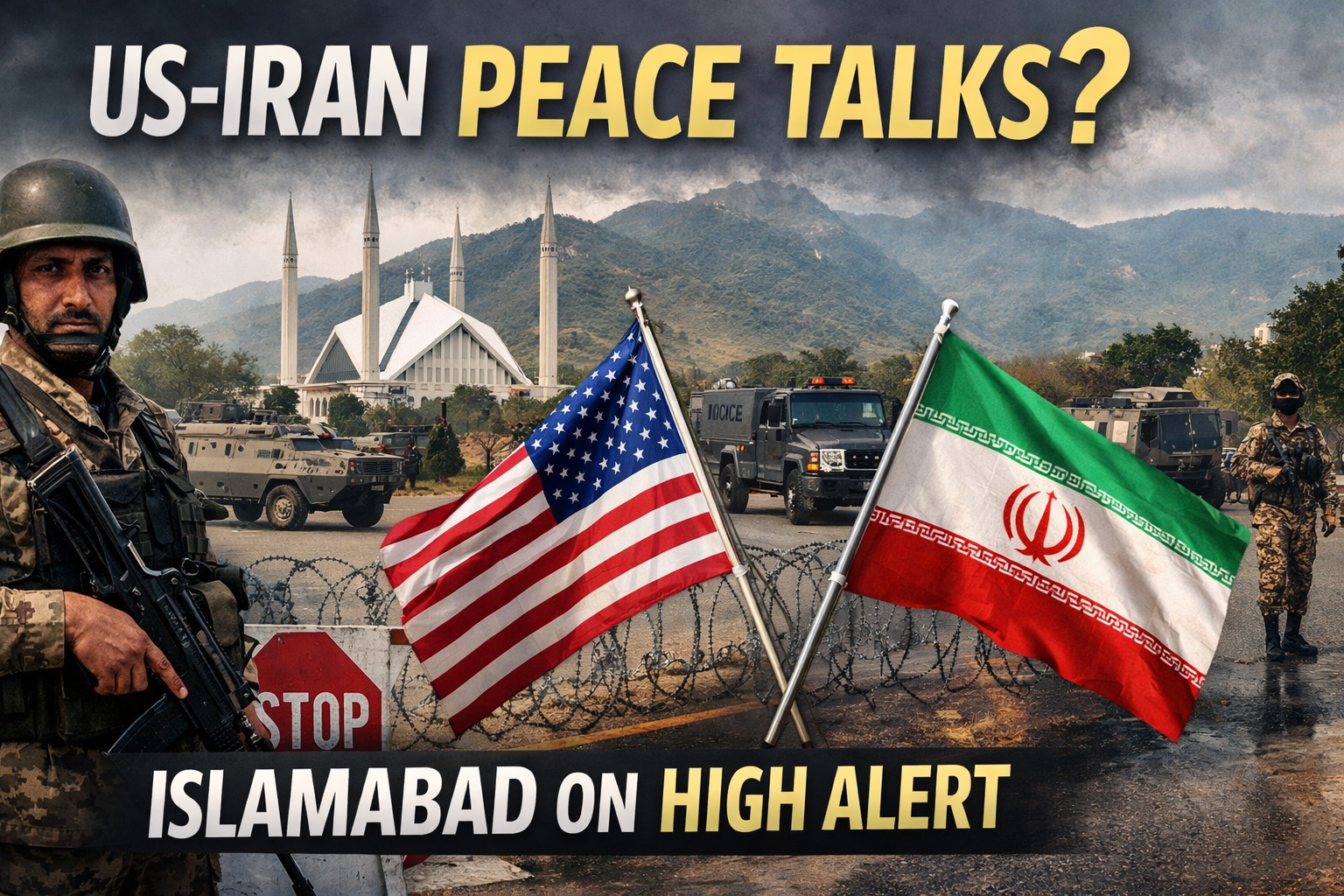
Islamabad has entered a state of extraordinary security as Pakistan prepares for a possible new round of high-stakes peace negotiations between the United States and Iran. What was already a tense diplomatic moment has now turned the capital into a controlled zone, reflecting both the importance of the talks and the fragility of the situation.
A City on Lockdown
In recent days, authorities have imposed sweeping restrictions across Islamabad. Key areas—especially the Red Zone—have been sealed, major roads closed, and transportation services suspended. Hotels in sensitive locations have been vacated or fully reserved for delegations, while security forces have been deployed in large numbers.
This is not the first time such measures have been taken. Earlier rounds of negotiations also saw the city effectively shut down, with thousands of personnel guarding key venues and international media centers.
The scale of the lockdown reflects a simple reality: Islamabad is now at the center of one of the most critical diplomatic efforts in recent years.
Why These Talks Matter
The negotiations are part of a broader attempt to stabilize a fragile ceasefire in the 2026 Iran conflict—a war that has already disrupted global energy markets and heightened tensions across the Middle East.
Pakistan has emerged as a key mediator, hosting direct, high-level talks between the US and Iran—something rarely seen since the 1979 Iranian revolution.
Previous discussions in Islamabad lasted over 20 hours but failed to produce a final agreement, largely due to disagreements over Iran’s nuclear program and control of the Strait of Hormuz.
Still, both sides left the door open for further dialogue, keeping hopes alive for a breakthrough.
Rising Tensions Behind the Scenes
Despite diplomatic efforts, the situation remains volatile. Iran has threatened to boycott the upcoming talks, accusing the United States of unrealistic demands and inconsistent positions.
At the same time, military tensions continue to escalate. The US recently seized an Iranian-linked vessel, while Iran has tightened control over strategic shipping routes, further complicating negotiations.
These developments highlight a dangerous paradox: while diplomacy is ongoing, the risk of conflict escalation has not disappeared.
Uncertainty Over What Comes Next
Officials have not formally confirmed the next round of talks, but signs strongly suggest that negotiations could resume within days.
However, uncertainty remains. Conflicting signals from both sides, shifting demands, and geopolitical pressures have made the process unpredictable. Analysts warn that even small missteps could derail progress.
Pakistan’s Diplomatic Moment
For Pakistan, hosting these talks is both an opportunity and a challenge. Acting as a mediator between two long-time adversaries has elevated Islamabad’s global diplomatic profile. At the same time, it has placed the country under intense scrutiny and security pressure.
The current lockdown is a visible reminder of the stakes involved—not just for Pakistan, but for the wider world.
Final Thoughts
Islamabad’s lockdown is more than a security measure—it is a signal of how critical these negotiations have become. The outcome of these talks could shape regional stability, global energy markets, and future US–Iran relations.
For now, the city waits—quiet, controlled, and under watch—as the world looks toward Islamabad for what could be a turning point in one of the most complex conflicts of our time.