
Islamabad
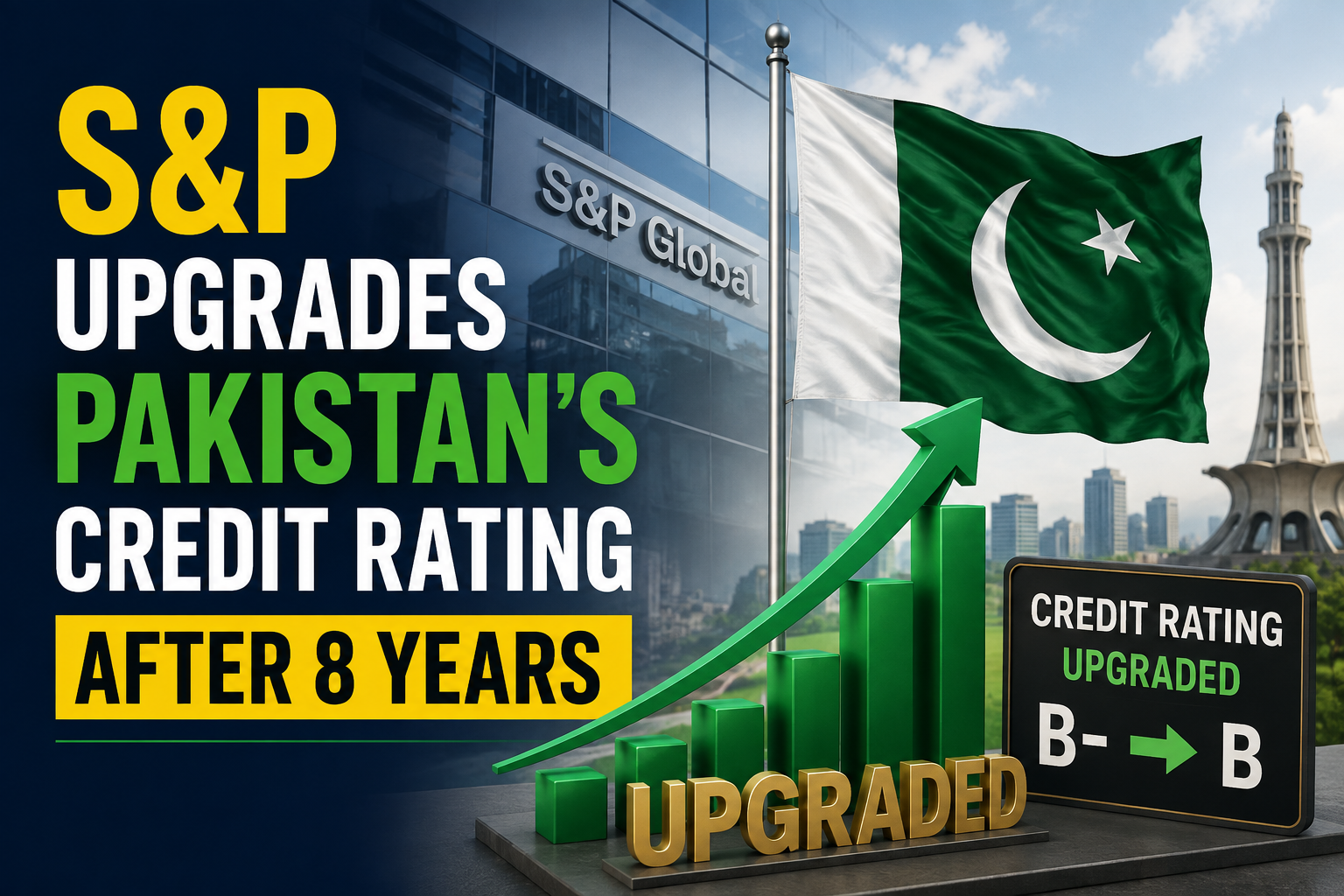
There is some good news coming from the economy front. Global rating agency S&P has upgraded Pakistan’s long-term sovereign credit rating.
After almost 8 years, Pakistan’s rating has moved up from “-B” to “B”.The announcement came on Friday, and it surprised many people in the market.For common people, a credit rating may sound like a technical term. But it actually matters a lot.A better rating means the world thinks Pakistan is now a little more stable with money matters.S&P said the main reason behind this upgrade is better foreign exchange reserves.
The agency also pointed to improved fiscal discipline by the government.
Another big factor was Pakistan’s progress under the IMF program.
Let’s break it down in simple words.
When a country has more dollars in its bank, lenders feel safer.
When the government spends carefully and collects taxes properly, rating agencies take notice.
And when the IMF says you are following the plan, the world listens.
That is exactly what happened with Pakistan.
The S&P report said Pakistan’s external position has improved compared to last year.
It also mentioned that inflation has started to come down.
Interest rates are still high, but the direction looks better now.
Experts say this upgrade will help Pakistan borrow money from international markets at a lower cost.
Think of it like this. If your credit score in a bank goes up, you get a loan on better terms.
It is the same for countries.
A “B” rating is still not great. It is called “speculative” or “junk” grade.
But moving up from “-B” is still a step forward.
The last time Pakistan saw an upgrade like this was almost 8 years ago.
So for many analysts, this is a big deal.
Finance ministry officials welcomed the decision.
They said it reflects the government’s efforts to fix the economy.
One official said, “We are not out of the woods yet, but we are moving in the right direction.”
The State Bank also issued a short statement.
It said the upgrade shows confidence in Pakistan’s economic policies.
Market reaction was positive on Friday.
The Pakistan Stock Exchange opened on a green note.
The rupee also held steady against the dollar at Rs278.70 in interbank trading.
Investors say a better rating can bring more foreign investment.
Foreign companies look at these ratings before putting money in a country.
If they see “B” instead of “-B”, they feel a little more comfortable.
But not everyone is celebrating.
Some economists are asking for caution.
They say one upgrade does not fix all problems.
Pakistan still has a large debt burden.
The country still needs to increase exports and reduce imports.
Tax collection is better, but the informal economy is still huge.
Power sector circular debt is still a headache.
And the common man is still feeling the pressure of inflation.
Just this week, the government increased petrol prices by Rs4.45 per liter.
That kind of news makes people wonder how much the rating really helps them.
An economist in Karachi said, “This is good for the balance sheet, but the street needs to feel it too.”
Another analyst said the real test will be the next 6 to 12 months.
Can Pakistan keep reserves stable?
Can it stay on track with IMF targets?
Can it avoid any big political or security shocks?
If yes, then another upgrade is possible.
If not, then this gain could be reversed quickly.
S&P itself said the outlook is “stable”.
That means they do not expect another upgrade or downgrade immediately.
They will watch how Pakistan manages its budget, debt, and reserves.
The government has set a target of $10 billion in trade with regional partners.
It is also working on new deals with Saudi Arabia, Turkiye and Iran.
The Makkah Defence Pact was also announced this week.
Officials say these diplomatic moves can help economic ties too.
But trade and politics move slowly.
Ratings move faster.
For now, the upgrade gives Pakistan some breathing room.
It sends a signal to the world that Pakistan is trying to get its house in order.
For overseas Pakistanis, it may mean more confidence in sending remittances.
For local businesses, it may mean easier access to foreign loans.
For students and professionals, it may mean a slightly better image of Pakistan abroad.
But the real change will come when jobs are created.
When prices in the market come down.
When people feel less pressure at the grocery store.
That is what people in Peshawar, Lahore and Karachi care about most.
The government knows this.
That is why officials are talking about “growth with stability”.
They are also talking about digital reforms and tax automation.
Punjab has already launched AI Vision 2029.
Other provinces are being asked to follow.
NAB also handed over Rs6 billion in recovered assets to KP government this week.
Small steps, but steps in the right direction.
Back to S&P. The report was clear.
Better reserves. Better fiscal numbers. Better IMF compliance.
That is the formula.
Now the government has to keep following it.
No shortcuts. No sudden policy U-turns.
International lenders will be watching closely.
So will local businesses.
So will you and me.
Final Thoughts
Look, a credit rating upgrade is not magic.
It will not bring petrol prices down tomorrow.
It will not fill your fridge next week.
But it is like getting a pat on the back from the world.
It says, “Okay, we see you are trying.”
After years of downgrades, crises, and tough IMF talks, that pat matters.
Pakistan has moved from “-B” to “B”.
It is a small step, but in the economy, small steps add up.
If the government keeps reserves strong, keeps spending under control, and keeps talking to the IMF honestly, then maybe next year we talk about “B+”.
If not, we could slip back.
The choice is not with S&P.
The choice is with us – the government, the institutions, and the people.
For now, let’s take this as a small win.
And then get back to work.
Because the real rating that matters is the one people give when they go to the market.